
Bleed (Hemorrhage) is one of the strongest status effects in Elden Ring because it deals burst damage based on the enemy's maximum HP.
To trigger Bleed, you must fill an enemy's hidden Blood Loss meter through repeated attacks.
The best Bleed builds usually combine:
- Arcane scaling
- Fast weapons (katanas, twinblades, daggers)
- Lord of Blood's Exultation
- Seppuku or bleed-focused weapon skills
For most Level 150 builds, 45 Arcane is the key breakpoint.
This guide explains how does bleed work in Elden Ring, how Arcane affects buildup, the best Bleed weapons ranked, and the strongest Bleed builds for 2026.
Before you build your bleed character, check your stat efficiency with the Elden Ring Build Planner.
Quick Answer
Bleed works by building a hidden Blood Loss meter with each hit. When the meter fills, Hemorrhage triggers and deals burst damage equal to roughly 15% of the enemy's maximum HP.
Key facts:
- Bleed damage scales with enemy HP, not your weapon AR
- Arcane increases how fast bleed builds up, not how much damage it deals
- ARC 45 is the soft cap for bleed buildup on most weapons
- Faster weapons (katanas, twinblades, daggers) proc bleed more often
- Bleed ignores enemy defenses — it deals the same damage regardless of armor
- Some bosses (Elden Beast, Radagon, DLC bosses) are highly resistant
How Does Bleed Work in Elden Ring?
Every weapon with a bleed property applies a hidden buildup value per hit.
Step by step:
- You hit an enemy with a bleed weapon
- A hidden Blood Loss meter increases by the weapon's bleed value
- When the meter hits the enemy's bleed resistance threshold, Hemorrhage triggers
- The enemy takes percentage-based HP damage (~15% of max HP)
- The meter resets to zero and starts building again
Buildup Formula
Effective Buildup = Weapon Base Bleed × Arcane Scaling Multiplier
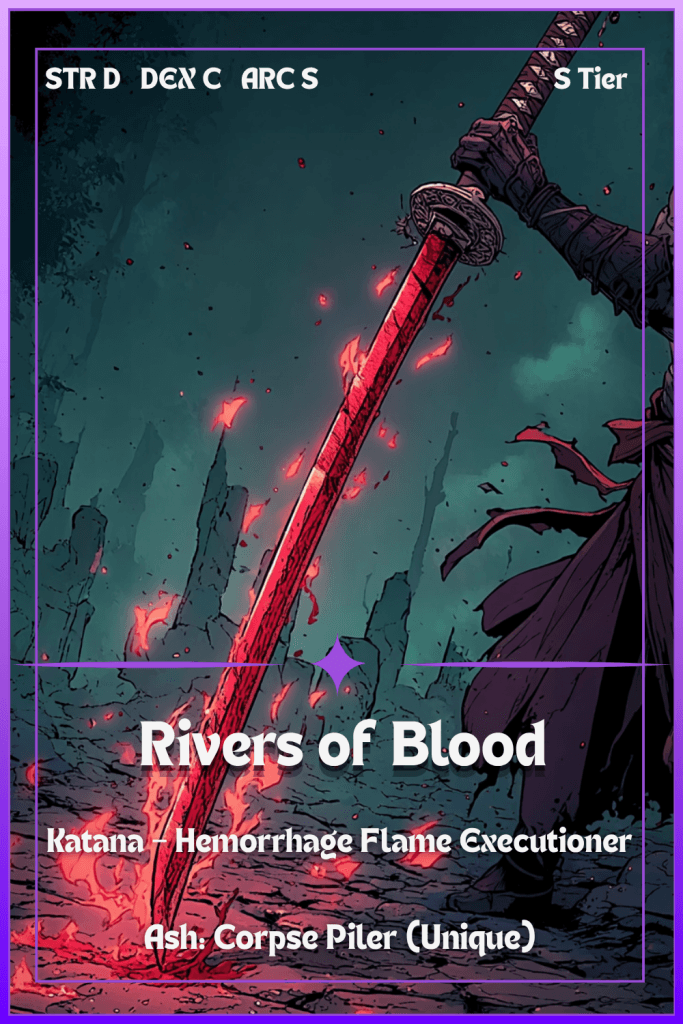
- Weapon Base Bleed: Listed in weapon stats (e.g., Rivers of Blood = 45 per hit)
- Arcane Scaling: Up to +40% bonus at ARC 45
- Multi-hit attacks (Corpse Piler, Eleonora's skill) apply bleed per hit
Why Bleed Is So Strong
- Scales with enemy HP — stronger enemies = more bleed damage
- Ignores defenses — bleed deals the same damage regardless of armor
- Fast weapons excel — katanas, twinblades, and daggers proc bleed frequently
- Bosses are vulnerable — most bosses can be bled, including Malenia
Best Elden Ring Bleed Build (Level 150)
This is the most popular and effective bleed build for Elden Ring in 2026. Optimized for maximum bleed procs, survivability, and boss damage.
Class: Samurai
Stats (RL 150)
| Stat | Value |
|---|---|
| Vigor | 60 |
| Mind | 15 |
| Endurance | 25 |
| Strength | 20 |
| Dexterity | 50 |
| Arcane | 45 |
Weapons
| Slot | Weapon | Affinity |
|---|---|---|
| Main Hand | Rivers of Blood +10 | Default |
| Off-Hand | Nagakiba +25 | Occult (Seppuku) |
Talismans
| Talisman | Effect |
|---|---|
| Lord of Blood's Exultation | +20% attack power when bleed procs |
| Shard of Alexander | +15% weapon skill damage |
| Rotten Winged Sword Insignia | +13% damage on consecutive hits |
| Dragoncrest Greatshield | +20% physical damage negation |
Playstyle
- Use Seppuku on off-hand Nagakiba before boss fights
- Two-hand Rivers of Blood
- Spam Corpse Piler weapon skill for rapid bleed procs
- Swap to physical damage weapons against bleed-immune enemies
See our detailed Best Bleed Build Guide for the complete setup.
Best Bleed Weapons Ranked
The best bleed weapon depends on your playstyle. Here is the definitive ranking for Elden Ring 2026:
Compare weapon AR with the Weapon AR Calculator.
| Rank | Weapon | Best For | Bleed Buildup | Why |
|---|---|---|---|---|
| 1 | Nagakiba | Best overall | 45 (high) | Longest range katana, Occult scaling, versatile moveset |
| 2 | Rivers of Blood | Weapon skill burst | 45 (high) | Corpse Piler multi-hit, highest DPS vs bleedable enemies |
| 3 | Eleonora's Poleblade | Fastest buildup | 40 (high) | 6-hit weapon skill, fastest bleed proc in the game |
| 4 | Reduvia | Early game | 30 (medium) | Ranged bleed projectile, easy to proc from distance |
| 5 | Scavenger's Curved Sword | Dual wield | 45 (high) | Fast attack speed, best paired setup for jump L1 |
| 6 | Mohgwyn's Sacred Spear | AoE bleed | 35 (medium) | Powerful weapon art with long reach |
| 7 | Uchigatana | Starter katana | 45 (high) | Blood affinity scaling, Samurai class starting weapon |
| 8 | Godskin Peeler | Twinblade speed | 40 (high) | Multi-hit combos, natural bleed affinity |
| 9 | Flamberge | Strength bleed | 45 (high) | Greatsword with bleed — rare combo for STR builds |
| 10 | Great Stars | STR build | 35 (medium) | Heals on hit, good for strength-focused play |
| 11 | Bloodhound's Fang | First playthrough | 30 (medium) | Quality bleed, great for first run |
Arcane Scaling Explained
Arcane is the most important stat for bleed builds, but its role is widely misunderstood.
Does Arcane Increase Bleed Damage?
No. Arcane increases buildup speed, not damage per proc.
This is the most common mistake bleed build players make.
What Arcane Actually Does
| Arcane Level | Effect |
|---|---|
| 1-20 | Minimal bleed scaling |
| 20-45 | Significant bleed buildup increase (up to +40% at 45) |
| 45 | Soft cap — bleed buildup gains slow significantly |
| 60 | Second soft cap — only worth it for Occult infusion builds |
Real Example: Nagakiba (Blood Affinity)
| Arcane | Bleed Buildup | Hits to Proc on Boss |
|---|---|---|
| 20 | 78 | ~10 hits |
| 45 | 109 | ~7 hits |
| 60 | 118 | ~7 hits |
The jump from 20 to 45 Arcane reduces the hits needed by 30%. The jump from 45 to 60 barely helps.
See Arcane Soft Caps Explained for the full stat breakdown.
Bleed Damage Formula
Hemorrhage damage is based on the enemy's maximum HP, not your weapon AR.
General Rule
- Normal enemies: ~15% max HP per proc
- Bosses: Reduced by bleed resistance stat (typically 10-13% effective)
- Players (PvP): ~15% + flat 100 damage
Examples
| Enemy | Max HP | Bleed Damage Per Proc | Procs to Kill |
|---|---|---|---|
| Soldier | 500 | ~75 | 6-7 |
| Malenia | 40,000 | ~5,200 (13%) | ~8 |
| Mohg | 45,000 | ~5,850 (13%) | ~8 |
| Player (PvP) | 1,900 | ~385 | 5 |
Formula
Bleed damage is calculated from the enemy's maximum HP and internal Hemorrhage modifiers.
Where:
- Base Bleed % = 15% for most enemies
- Bleed Resistance = 0.10-0.30 for bosses (higher = more resistance)
- Bleed-immune enemies = 100% resistance (Elden Beast, Radagon, Crystalians)
Bleed vs Frost vs Poison vs Scarlet Rot
| Effect | Type | Damage | Best Against |
|---|---|---|---|
| Bleed | HP burst on proc | ~15% max HP | High-HP bosses, PvP |
| Frost | Burst + debuff | ~10% max HP + -20% defense | Most enemies, debuff value |
| Poison | Damage over time | ~7% max HP over 90s | Long fights, chip damage |
| Scarlet Rot | Heavy DoT | ~15% max HP over 60s | Large/slow bosses |
| Sleep | Crowd control | 0 damage | Godskin enemies, PvP setups |
Best Talismans for Bleed Builds
These talismans maximize bleed performance.
Lord of Blood's Exultation 🏆
- +20% attack power when bleed procs nearby
- Essential for any bleed build
- Activates from Seppuku self-bleed
Rotten Winged Sword Insignia
- +10% damage on consecutive hits, +13% upgraded
- Synergizes perfectly with multi-hit bleed weapons
Millicent's Prosthesis
- +5 Dexterity + damage on consecutive hits
- Pairs with Rotten Winged Sword for maximum value
Shard of Alexander
- +15% weapon skill damage
- Critical for Rivers of Blood and Eleonora's builds
Dragoncrest Greatshield Talisman
- +20% physical damage negation
- Essential survival for aggressive bleed playstyle
What Affects Bleed Buildup?
Several factors determine how quickly you trigger Hemorrhage.
1. Arcane Stat
The biggest factor. ARC 45 is the most important breakpoint for any bleed build.
2. Attack Speed
Faster weapons proc bleed more often. A katana hitting 3 times in a jump L1 builds the meter faster than a greatsword hitting once.
3. Weapon Affinity
- Blood Affinity: +50-70% bleed buildup, -20% physical damage
- Occult Affinity: +Arcane scaling, better raw damage, slightly lower bleed
- Standard: Lowest bleed but highest physical damage
4. Dual Wielding
Two bleed weapons = double the buildup per attack. Jump L1 with dual katanas applies bleed on both weapons simultaneously.
5. Weapon Skills
- Corpse Piler (Rivers of Blood): 3-4 hits per skill use
- Eleonora's skill: 6 hits
- Seppuku: +30 bleed buildup for 60 seconds
Best Ashes of War for Bleed Builds
The right Ash of War can double your bleed effectiveness.
1. Seppuku 🏆 (Best Overall)
- Grants +30 bleed buildup for 60 seconds
- Activates Lord of Blood's Exultation automatically
- Best for boss fights and high-HP enemies
2. Corpse Piler (Rivers of Blood exclusive)
- 3-4 hits per use = massive bleed buildup in 1 second
- High stance damage, long range
- Best weapon skill in the game for bleed
3. Bloody Slash
- High burst damage + bleed in one attack
- Early game accessible (Fort Haight)
- Good for clearing tough early enemies
4. Double Slash
- Rapid 2-hit sequence
- Excellent with Blood affinity on katanas
- Low FP cost (12 FP)
How to Build a Bleed Character Step by Step

Building a bleed character from scratch can be overwhelming. This step-by-step progression works for new players starting at any class.
Level 1-30: Starter Phase
- Start as Samurai or Bandit
- Uchigatana is the best starting weapon — innate bleed, no investment needed
- Focus on Vigor first (target 25), then Dexterity
- Ignore Arcane at this stage — early Arcane levels have almost no effect on bleed buildup
- Get Smithing Stone 1-3 to upgrade your weapon to +3
Level 30-60: Early Game Optimization
- Push Arcane toward 25 — bleed buildup starts to noticeably improve
- Acquire Reduvia for ranged bleed procs
- Get Bloodborne Grease consumable for the first Lord of Blood's Exultation equivalent
- Target Vigor 30, Dexterity 25, Arcane 25
- Upgrade weapon to +7
Level 60-100: Mid Game Build
- Push Arcane toward 45 — the most efficient breakpoint for Blood affinity weapons
- Transition from Blood affinity to Occult affinity if going for high-level build
- Acquire Rivers of Blood or Nagakiba
- Get Lord of Blood's Exultation talisman
- Use Seppuku Ash of War for the +30 bleed buff
Level 100+: Endgame Optimization
- ARC 45 is the most efficient breakpoint for many Blood affinity weapons. For high-level Occult builds, pushing Arcane toward 60 can still improve overall damage.
- Push Dexterity to 50 for weapon damage scaling
- Vigor 60 for survival
- Build around 2-3 weapon swaps for bleed-immune bosses
Bleed vs Bosses: Who to Use It On
| Boss | Bleed Viability | Notes |
|---|---|---|
| Malenia | ✅ Excellent | Easiest bleed target, procs every 4-5 hits |
| Mohg, Lord of Blood | ✅ Excellent | Weak to bleed despite being the blood lord |
| Godfrey / Hoarah Loux | ✅ Good | Bleed builds melt him in phase 1 |
| Morgott | ✅ Good | Fast bleed procs, easy fight with bleed |
| Fire Giant | ✅ Good | Large HP pool = high bleed value |
| Maliketh | ⚠️ Mixed | Phase 1 good, phase 2 resistant |
| Radagon / Elden Beast | ❌ Immune | Cannot bleed at all — bring a backup weapon |
| Crystalians | ❌ Immune | Fully immune to bleed |
| DLC Bosses | ⚠️ Mixed | Most have 30-50% bleed resistance, some are immune |
When Should You NOT Use Bleed?
Bleed is not a universal solution. There are situations where investing in bleed is a waste of levels.
Bleed-Immune Enemies
These enemies cannot be bled at all, making any bleed build ineffective:
- Elden Beast — fully immune
- Radagon of the Golden Order — fully immune
- Crystalians (Crystal Hollows, Raya Lucaria) — fully immune
- Mohgwyn Dynasty soldiers — high resistance, barely procs
Bleed-Resistant Scenarios
- Undead and skeletons — most undead are immune or highly resistant
- Shadow of the Erdtree DLC bosses — many have 30-50% bleed resistance
- PvP with bleed-immune setups — some PvP builds use bleed protection
When NOT to Invest in Bleed
- You plan to rush the DLC and face heavy bleed resistance
- You prefer pure damage builds without status complexity
- You cannot carry a backup weapon for immune bosses
- You are new to the game — raw damage builds are simpler to learn first
Rule of thumb: If 20% of your fights are against bleed-immune enemies, a pure bleed build is not optimal.
Common Bleed Mistakes
Mistake 1: Thinking bleed damage scales with your stats
Bleed damage is based on the target's max HP, not your stats. Higher Arcane means faster procs, not bigger procs.
Mistake 2: Ignoring Arcane 45 breakpoint
After 45 Arcane, bleed buildup gains slow significantly. Those 15 points from 45 to 60 are better spent on Dexterity or Vigor.
Mistake 3: Using Blood Affinity at high levels
Occult affinity provides better Arcane scaling and higher raw damage. Transition to Occult once you hit ARC 45.
Mistake 4: No backup for bleed-immune bosses
20% of bosses are immune to bleed. Always carry a non-bleed weapon (occult or standard) for Elden Beast, Radagon, and Crystalians.
FAQ
Does bleed work on Malenia?
Yes — Malenia is one of the easiest bosses to bleed. With a dual katana setup and Seppuku, you can proc bleed every 4-5 hits.
Can you bleed Elden Beast?
No. Elden Beast and Radagon are both immune to bleed. You need a non-bleed backup weapon for this fight.
Does Arcane increase bleed damage?
No. Arcane increases buildup speed, not damage per proc. This is the most common misunderstanding about bleed builds.
How much damage does bleed do?
Approximately 15% of the enemy's maximum HP per proc for normal enemies, and 10-13% for bosses depending on their bleed resistance.
What is the best Arcane level for bleed?
45 Arcane is the most efficient breakpoint. After 45, bleed buildup gains slow significantly. ARC 60 is a second soft cap worth it only for Occult infusion builds.
Does bleed work on DLC bosses?
Bleed works in Shadow of the Erdtree, but many bosses have 30-50% bleed resistance. Pure bleed builds need backup strategies for the hardest DLC encounters.
Is bleed better than frost?
Bleed deals more burst damage, but Frost provides a -20% defense debuff. They stack well together — the "Bleedfrost" build uses both simultaneously.
Is Arcane better than Dexterity for bleed?
It depends on your level. ARC 45 is the priority for bleed buildup. After that, Dexterity provides better weapon damage scaling. At RL 150: 50 DEX / 45 ARC is optimal.
Does Seppuku still work in 2026?
Yes. Seppuku grants +30 bleed buildup for 60 seconds and activates Lord of Blood's Exultation. It remains the strongest Ash of War for bleed builds.
Does dual wielding increase bleed?
Yes. Dual wielding applies bleed from both weapons simultaneously. Jump L1 with dual katanas is the fastest way to proc bleed.
What is the fastest bleed weapon?
Eleonora's Poleblade. Its weapon skill hits 6 times in one use, building bleed faster than any other weapon. Rivers of Blood is second (3-4 hits per skill).
Is bleed good in Shadow of the Erdtree?
Bleed works in the DLC, but many bosses have 30-50% bleed resistance. Pure bleed builds need backup strategies for the hardest DLC encounters.
What level should I stop at for bleed?
RL 150 is the most popular breakpoint. It allows 60 Vigor + 45 Arcane + 50 Dexterity. RL 125 works for PvP bleed builds but requires sacrificing either Vigor or damage.
Does bleed work on undead enemies?
No. Most undead enemies (Those Who Live in Death, skeletons) are immune or highly resistant to bleed.
Can I use bleed with a Strength build?
Yes. Great Stars, Ghiza's Wheel, and the Flamberge all have innate bleed. The buildup is slower than katanas, but the raw damage is higher.
Is Blood Affinity or Occult better for bleed?
Blood Affinity for low-mid Arcane (under 45). Occult for high Arcane (45+). Occult provides better raw damage while maintaining good bleed buildup.
How many hits to proc bleed on a boss?
With Rivers of Blood at ARC 45: approximately 4-5 hits on Malenia, 5-6 on Mohg, 7-8 on Fire Giant.
Does bleed stack with Frost?
Yes. Bleed and Frost can be applied simultaneously. This is the basis of the "Bleedfrost" build — bleed for burst, frost for defense debuff.
What is the best starting class for bleed?
Samurai starts with the Uchigatana (innate bleed) and high Dexterity. Bandit starts with high Arcane for immediate bleed scaling. Samurai is better for new players, Bandit for experienced players.
Is bleed worth using in PvP?
Yes. Bleed is one of the strongest PvP strategies. Fast weapons + bleed pressure forces opponents into mistakes. Lord of Blood's Exultation + Shard of Alexander makes Corpse Piler a one-shot combo against most players.
Conclusion
Bleed is one of the most powerful mechanics in Elden Ring. Its percentage-based damage scales with enemy health pools, making it devastating against bosses.
Key takeaways:
- ARC 45 is the most important breakpoint
- Faster weapons = faster procs = higher DPS
- Seppuku + Lord of Blood's Exultation is the core combo
- Always carry a backup for bleed-immune bosses
- Use Occult affinity at high Arcane levels
Test your bleed build with the Elden Ring Build Planner before committing Larval Tears.